Washing Machine Assembly Line
This washing machine assembly line is engineered specifically for the high-volume production of top-load washers[…]
Email:[email protected]
We are a home appliance assembly line manufacturer.
Tel:+86-13858631358 Mail:[email protected]
This washing machine assembly line is engineered specifically for the high-volume production of top-load washers[…]
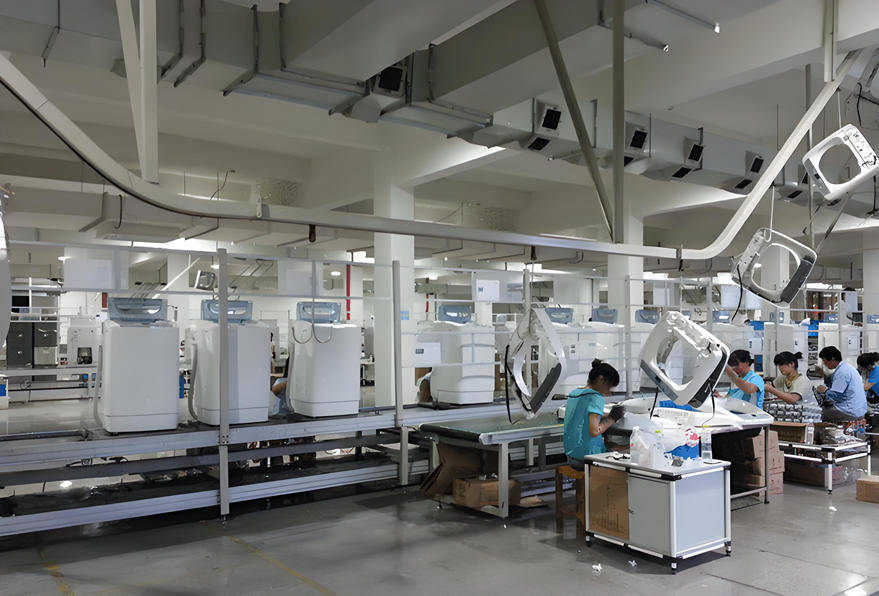
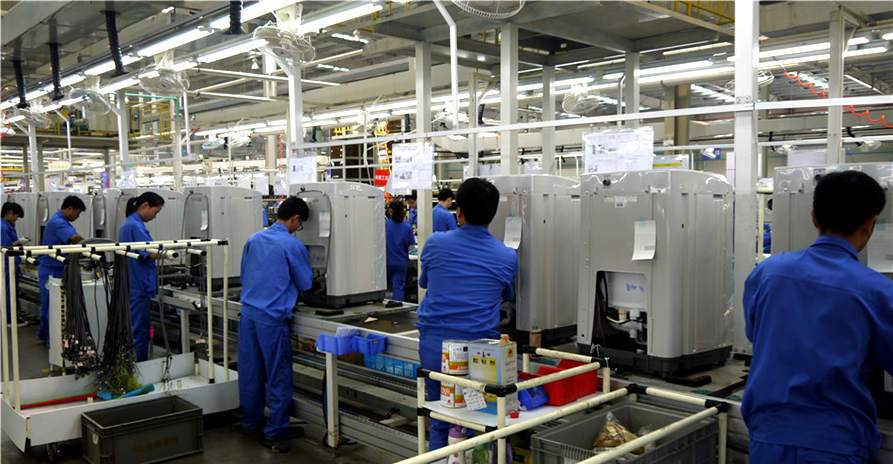
This washing machine assembly line is engineered specifically for the high-volume production of top-load washers, catering to both household and commercial sectors. As a dedicated washing machine production line, it employs a modular and flexible design to manage the complete manufacturing cycle—from cabinet infeed to final product outfeed. The washer assembly line integrates five core modules: the conveyor system, assembly stations, inspection units, logistics interfaces, and a centralized control system. This architecture ensures precise process synchronization and data integrity, providing a stable foundation for large-scale manufacturing operations.
Conveyor System
The main line utilizes an accumulating roller conveyor designed for a load capacity of ≥300 kg/m, featuring a roller pitch of 150 mm to suit standard cabinet dimensions. Variable frequency drives allow speed adjustments between 0.3–1.5 m/min, synchronizing the washing machine assembly line with upstream stamping and injection molding processes. To ensure stability, nylon guide rails are installed along the track to prevent cabinet abrasion, while cone-shaped rollers facilitate smooth transitions on R=500 mm turns. Critical workstations are equipped with lift-and-rotate fixtures capable of 90° or 180° rotation, enabling efficient bottom-side assembly. Pneumatic stops provide positional accuracy within ±1 mm.
Assembly Process Flow
The washing machine production line is configured with ten primary stations, sequenced to optimize assembly efficiency:
Control and Inspection Architecture
The control infrastructure of this washer assembly line is built on Siemens S7-1200 PLCs managed via a WinCC SCADA system. Real-time data acquisition covers critical parameters including current, voltage, pressure, temperature, and RPM, all logged into the MES for traceability. The system enforces quality through machine vision (5MP cameras and laser displacement sensors) for dimensional checks and automated shutdowns triggered by parameter deviations. Fault codes are generated for specific units to facilitate root-cause analysis.
Logistics and System Integration
The washing machine assembly line interfaces seamlessly with upstream cabinet conveyors for automatic loading and downstream AGVs for warehouse transfer. Inter-station buffer zones (2 m length) prevent bottlenecks, while RFID-based error-proofing systems halt operations upon detection of incorrect part matching. The architecture supports full ERP/MES integration for work order management and quality data feedback loops.
Technical Specifications
Design Advantages
The modularity of this washing machine production line allows model changeovers in under 30 minutes. High-reliability components ensure a Mean Time Between Failures (MTBF) exceeding 8,000 hours, providing a robust foundation for scalable manufacturing operations.
Download PDF PDF / 234 KB
Previous: Refrigerator Assembly Line
Next: air conditioner assembly line