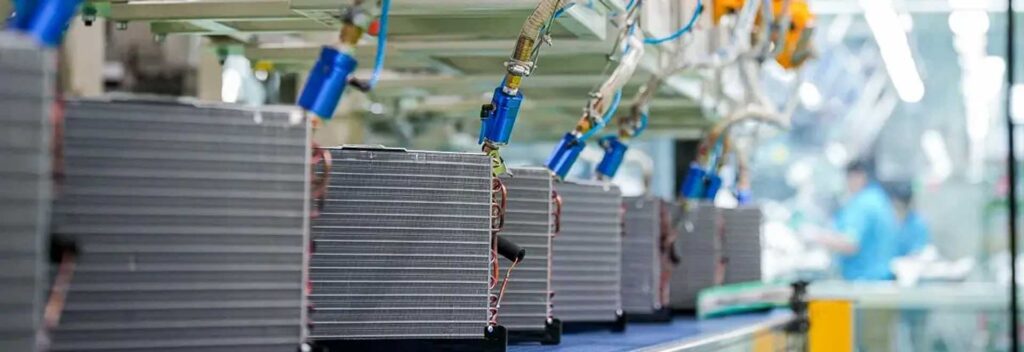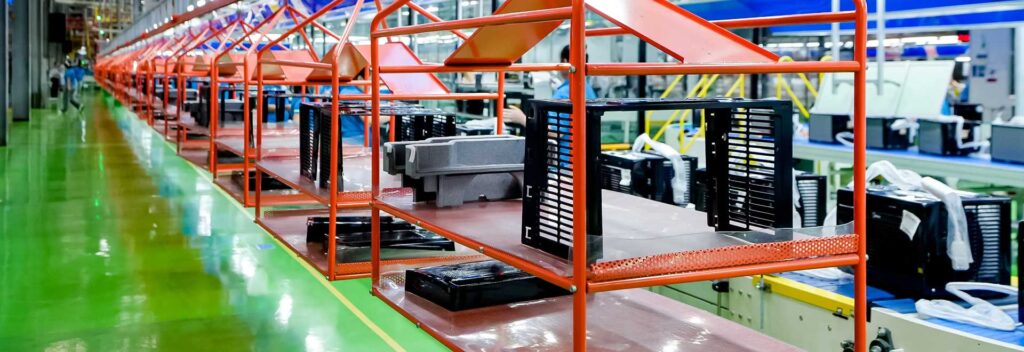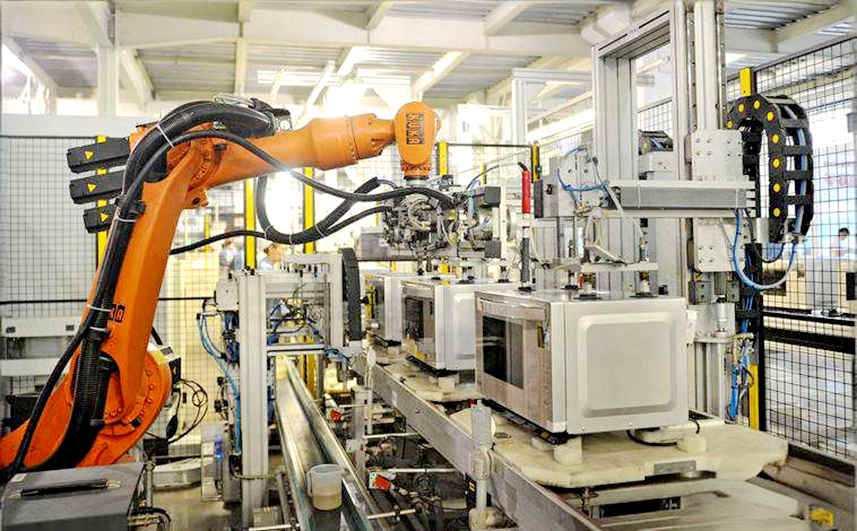
This is a highly efficient, automated microwave oven final assembly line. The core of its design utilizes a classic Welt Conveyor (dual-speed chain) drive mechanism. Unlike standard roller or belt conveyors, the welt chain design allows work carriers to achieve a smooth “accumulation” function during operation. This means upstream products can cache and wait during downstream congestion or brief stoppages without causing a system deadlock, making it ideal for microwave production, which involves numerous manual assembly steps with fluctuating cycle times.
I. Belt Conveyor System & Layout Design
The backbone of this line is a precision welt chain circulation system. The unique roller structure of the welt chain allows the work carriers, loaded with products, to move synchronously down the line while permitting individual lagging or stopping without halting the entire line.
- Dual-Level Return Design: The line features a visually distinct dual-level layout. The upper level serves as the main forward feed line carrying assembled microwaves, while the lower level utilizes pit space to create a return track. This allows empty carriers to automatically cycle back to the starting point without consuming additional factory floor space, maximizing spatial efficiency.
- Modular Aluminum Extrusion Frame: The entire line is supported by an industrial aluminum extrusion frame, offering structural rigidity while remaining lightweight. Semi-transparent anti-static soft curtains line both sides, effectively preventing airborne particulates from entering the assemblies during construction while ensuring adequate internal illumination.
II. Core Assembly & Functional Processes
Tailored to the technical requirements of “high-voltage and high-frequency, hermetically sealed cavities,” the workflow is arranged as follows:
- Cavity & Door Sub-assembly: Workers secure the stamped metal cavity to the work carrier and install the door hinges and safety interlock micro-switches. This station requires strict calibration of the door gap to ensure microwave leakage complies with safety standards.
- Magnetron & HV Assembly: Installation of the core heating component (magnetron) along with the high-voltage capacitor and diode. Due to the involvement of high-voltage circuits, this station mandates qualified personnel and the use of specialized insulated tools.
- Control Panel & Wiring: Connection of the membrane keypad panel and main control board wiring, followed by basic continuity testing.
- Safety & Performance Testing (FCT): Before leaving the line, each unit undergoes rigorous inline testing, including: door switch durability tests, microwave leakage scanning (LEAK TEST), and heating uniformity verification (typically using a standard water cup to observe boiling status).
- Final Packaging: Qualified products proceed to automatic cartoning machines for box packing and palletization.
III. Quality Control & Safety Monitoring
- Poka-Yoke (Error-Proofing): Positioning pins and RFID/chip identification are integrated into the work carriers. Only carriers with correctly installed doors and safety switches can pass specific inspection stations; otherwise, the system will alarm and block the item.
- Safety Interlocks: The line perimeter is equipped with yellow safety fences and emergency stop pull cords, compliant with ISO 10218 standards for industrial robotics and automation safety.
- Visual Management: Overhead monitors display Standard Operating Procedures (SOPs) and real-time process updates. Employees uniformly wear ESD-safe uniforms and finger cots to prevent fingerprint contamination on black micro-crystal panels.
IV. Technical Specifications
- Conveying Medium: 3x or 4x speed aluminum alloy chain (pitch 25.4mm / 38.1mm)
- Line Length: Approx. 50-80 meters (including return loop)
- Operating Speed: Variable frequency drive, standard carrier spacing 300mm – 600mm
- Rated Payload: ≥30 kg per work carrier
- Power Supply: 380V / 50Hz, 3-phase 5-wire system
- Availability (OEE): ≥85% (including manual operation buffer time)
V. Design Advantages
Compared to traditional slat or belt conveyors, the welt chain imparts significant flexibility to this microwave assembly line. It eliminates the need for complex sensor arrays to manage congestion; the physical accumulation capability inherently resolves assembly bottlenecks. Furthermore, the dual-layer structure creates a closed-loop logistics route, minimizing cross-traffic and double-handling, representing a classic solution for modern small appliance final assembly workshops.
Download PDF PDF / 212 KB