Gas Cooker Assembly Line
I. Overview A gas stove is the core cooking appliance in the modern kitchen. Its product structure include[…]
Email:[email protected]
We are a home appliance assembly line manufacturer.
Tel:+86-13858631358 Mail:[email protected]
I. Overview A gas stove is the core cooking appliance in the modern kitchen. Its product structure include[…]
A gas stove is the core cooking appliance in the modern kitchen. Its product structure includes a combustion system (burner head, divider, burner cap), a gas supply system (valve body, nozzle, gas pipe), an ignition system (pulse igniter), a safety protection system (thermocouple / flame failure device), and heavy stainless steel or tempered glass panels. The assembly process involves precise component mating, gas tightness testing, and electrical safety testing, placing extremely high demands on production takt control and in-process quality management.
It is particularly noteworthy that gas stoves are classified into three major categories based on applicable gas sources: Liquefied Petroleum Gas (Code Y), Natural Gas (Code T), and Artificial Coal Gas (Code R). Different gas sources have different rated pressures, nozzle diameters, and valve body structures, and must never be used interchangeably. This means that during production, a stove manufacturer often needs to switch and manufacture multi-fuel products on the same line according to order requirements — LPG stoves operate at 2800Pa, Natural Gas stoves at 2000Pa, and Artificial Coal Gas stoves at 1000Pa. Valve bodies and nozzles must be precisely matched to each gas type.
This solution provides a complete automated final assembly line solution for gas stoves. Through continuous conveying and paced workstation operations, it achieves standardized, end-to-end production from chassis loading, burner assembly, valve and pipe connection, panel closing, gas tightness testing, to final packaging. The line is widely adaptable to various product categories such as table-top gas stoves, built-in gas stoves, integrated stove modules, and commercial high-power stoves. It supports flexible mixed-line production for multi-fuel models, and also enables mixed-line production of single-burner (single-eye) and multi-burner (double-eye/triple-eye) products.
The line is specifically optimized for the heavy-material handling challenges in the gas appliance industry (e.g., tempered glass panels, cast iron burner heads) and strict safety testing requirements. Compared to traditional floor-assembly methods, it effectively solves industry pain points such as difficult handling of heavy components and susceptibility to collision damage. Through dedicated fixtures, heavy parts are transferred effortlessly, ensuring physical safety and gas path integrity during assembly, thereby steadily improving the factory pass rate and meeting the ex-factory requirements of the national standard GB 16410-2020 “Domestic Gas Cooking Appliances.”
Gas stove assembly on the line follows a sequence from core components to final enclosure. The line consists of multiple fixed workstations, each equipped with dedicated pneumatic/electrical quick-connect couplers and tool interfaces. The specific flow is as follows:
1. Chassis Loading: The stamped metal chassis is hoisted or placed onto the dedicated pallet on the conveyor. The pallet travels at a steady speed to the next station. (Note: The pallet is equipped with anti-scratch cushions to prevent damage to the chassis coating.)
2. Combustion System Assembly: At this station, the burner head, divider, large burner cap, and small burner cap are installed and initially fastened. The precise positioning of the conveyor system ensures these precision-cast parts do not shift during installation, which could otherwise cause gas leaks later.
3. Valve Body & Pipe Connection (Fuel-Specific): According to the order’s gas type (LPG Y / Natural Gas T / Artificial Coal Gas R), the corresponding specification gas valve body is installed, along with solenoid valves, the air inlet, and corrugated or aluminum pipes leading to the burner head. The matching nozzle with the correct diameter is synchronized. This station is equipped with quick-clamping devices to facilitate pipe connection and gas-type switching.
4. Ignition & Safety Device Installation: The pulse igniter and battery box are installed, and the micro-switch wiring is connected. Then the thermocouple (flame failure safety pin) is installed, ensuring its position aligns with the burner cap’s flame ports to guarantee subsequent safety testing.
5. Drip Pan & Panel Accessories Pre-Assembly: The drip pan and knob shaft sleeves are placed to prepare for panel closing.
6. Panel Closing & Fastening: A robotic arm or manual operation hoists the heavy tempered glass or stainless steel panel above the chassis, aligns the hinge positions for closing, and uses electric tightening machines to fasten the panel screws diagonally. The line’s load-bearing capacity ensures stability during the flipping and fastening of the fully assembled unit weighing over 20kg, effectively preventing collisions between the heavy panel and the chassis.
7. Whole-Unit Gas Tightness Testing: At the test station, the pallet carries the assembled unit into a gas tightness test chamber (or connects to an air nozzle). Pressurized gas is introduced, and high-precision sensors detect any leaks in the main intake pipe, nozzles, and all connection points. Non-conforming products are automatically rejected to eliminate safety hazards.
8. Visual Inspection & Packaging: After passing inspection, the gas stove moves to the packaging station for surface cleaning, film wrapping, placement into an explosion-proof bottom tray, insertion of manuals and accessories, and finally box sealing and off-line.
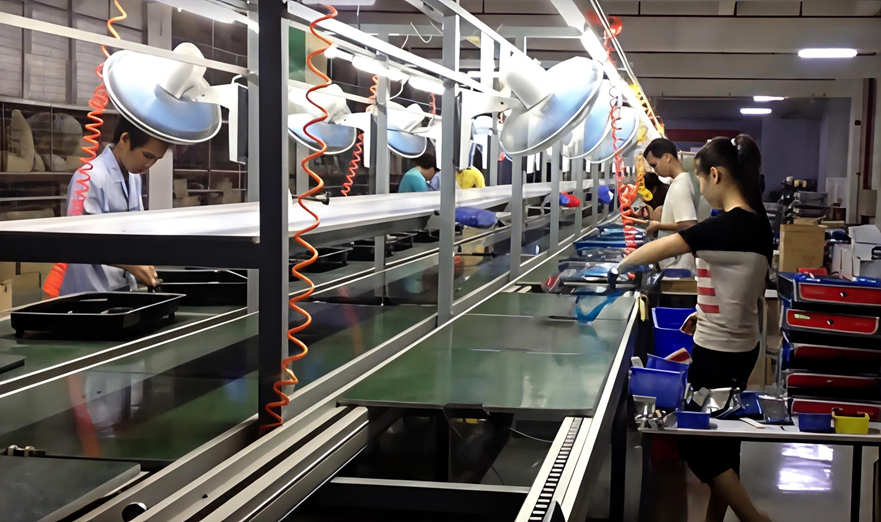
Throughout the entire process, the conveyor system handles all horizontal movement of heavy components. Workers only perform refined operations at fixed stations, achieving labor-saving and standardized assembly for heavy household appliances.
The core conveying mechanism of this line utilizes proven double-speed chain drive technology (core transmission mechanism), reinforced for the heavy-load demands of gas stove production. Its specifications and features are as follows:
| Item | Specification |
|---|---|
| Conveyor System | Core drive uses 3.0″ or 4.0″ heavy-duty double-speed chain, alloy steel, wear-resistant and high-tensile |
| Line Width | Customized based on maximum stove dimensions; standard range 1000mm–1500mm, with ample operating space |
| Pallet Specs | High-strength composite board or thickened aluminum plate, typically 1200mm×1200mm to 1500mm×1500mm; surface covered with anti-static, anti-scratch cushion; heavy-duty guide wheels at four corners |
| Conveying Speed | Variable frequency stepless speed control; standard assembly speed 1–6 m/min, suitable for slow, precise assembly of heavy products |
| Drive Configuration | High-power three-phase asynchronous motor (typically 2.2kW–4kW), paired with heavy-duty hardened gear reducer and high-performance inverter for smooth, shock-free start/stop |
| Control Method | Centralized PLC control; operation panel integrates Emergency Stop, Start, Reset, and speed adjustment, with independent interlock control for the gas tightness test station |
| Workstation Configuration | Each station standard-equipped with 220V/380V power outlets, pneumatic quick couplers, and communication interfaces for connecting test instruments. Optional: LED work lights, tool hooks, parts bins, and pneumatic balancers (for assisting panel lifting) |
Summary
With mature and reliable drive technology at its core, combined with the exclusive process requirements of the gas appliance industry (such as multi-fuel adaptation, single/multi-burner mixed-line capability, anti-collision design, and gas tightness test station integration), this gas stove automated final assembly line provides kitchen appliance manufacturers with an efficient, safe, and high-quality heavy-home-appliance assembly solution. The line can be customized non-standardly according to the actual factory layout and specific production capacity requirements.
Download PDF PDF / 136 KB
Previous: Massage Chair Assembly Line
Next: Drum Washing Machine Assembly Line