Massage Chair Assembly Line
A massage chair is a complex electromechanical product integrating multiple systems including mechanical guide ra[…]
Email:[email protected]
We are a home appliance assembly line manufacturer.
Tel:+86-13858631358 Mail:[email protected]
A massage chair is a complex electromechanical product integrating multiple systems including mechanical guide ra[…]
A massage chair is a complex electromechanical product integrating multiple systems including mechanical guide rails, drive motors, airbag pneumatic circuits, main control boards, and wiring harnesses. Its assembly involves a large number of components and complex wiring, placing high demands on production efficiency and quality consistency.
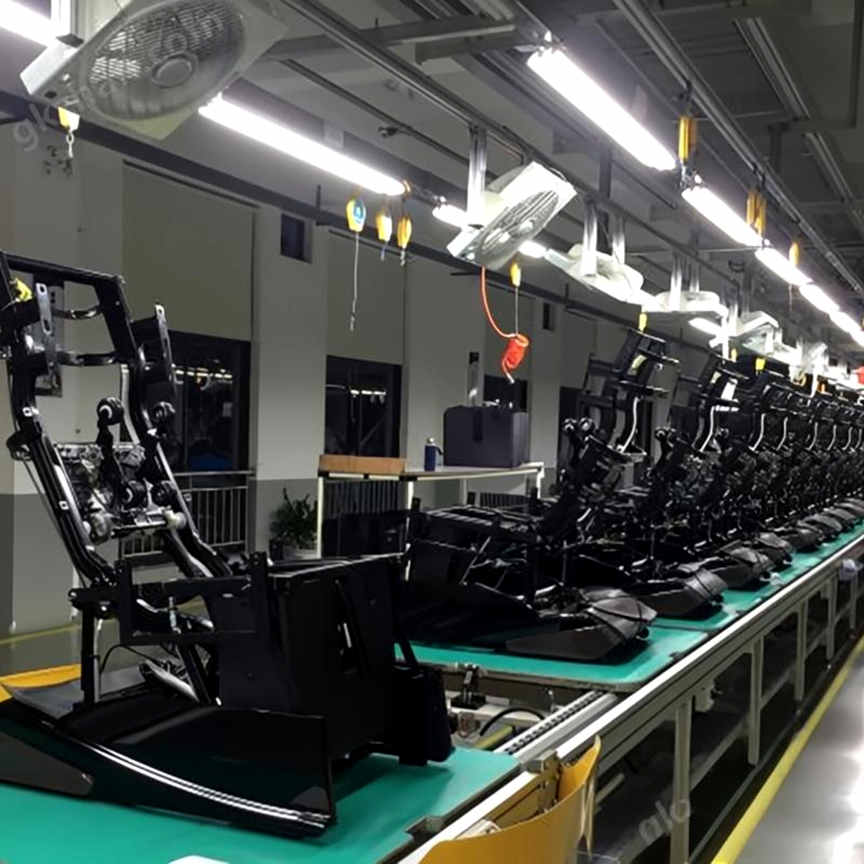
This solution provides a complete automated massage chair final assembly line. Through continuous conveying and paced workstation operations, it achieves standardized, end-to-end production from chassis loading to finished packaging. It is suitable for both dedicated and mixed-model production across a wide range of products—home massage chairs, commercial massage chairs, massage sofas, and zero-gravity massage chairs.
By decomposing and reorganizing the assembly process, this line significantly reduces material handling time, balances the workload across workstations, and steadily increases daily output compared to traditional floor-assembly or manual-carry methods.
Massage chair assembly on the line follows a sequence from internal to external, and from mechanical to electrical. The line consists of multiple fixed workstations, each equipped with dedicated operating space and tool interfaces. The specific flow is as follows:
1. Chassis Loading: The welded or powder-coated metal/wooden chassis is hoisted or placed onto the pallet on the conveyor. The pallet travels at a steady speed to the next station.
2. Mechanical Component Installation: At subsequent stations, guide rails are secured, travel motors are mounted, mechanical massage mechanisms are assembled, and linkage and backrest structures are connected. The line’s stop-and-position system ensures the pallet halts precisely at each station, allowing operators to fasten screws and perform alignment accurately.
3. Pneumatic & Wiring Harness Routing: Air pumps, airbags, and tubing are installed, while the main control harness and hand controller cables are laid out and pre-connected with proper bundling.
4. Electronic Control System Integration: The main control board, transformer, speakers, and display screen are installed, and all wiring connections are finalized to ensure every plug is properly seated.
5. Appearance Upholstery: Seat and backrest cushions are installed, followed by leather covers or stitched fabric panels, completing the full enclosure of the unit.
6. Functional Testing: At the test station, power is connected and automated diagnostic programs are run to verify the massage mechanism’s travel range, airbag inflation/deflation, heating function, and zero-gravity posture transitions.
7. Packaging & Off-Line: After passing inspection, the unit moves to the packaging station for film wrapping, boxing, and sealing, then is conveyed off-line or transferred to the warehouse area.
Throughout the entire process, horizontal movement of heavy loads is handled entirely by the conveyor system. Workers remain at fixed stations without the need to carry products. Pallets circulate automatically according to the set production takt, ensuring synchronization across all operations.
The core conveying mechanism of this line utilizes proven double-speed chain technology (core transmission mechanism). Its specifications and features are as follows:
| Item | Specification |
|---|---|
| Conveyor System | Core drive uses 2.5″ or 3″ double-speed chain, alloy steel with surface quenching treatment for wear resistance |
| Line Width | Customized based on maximum massage chair dimensions; standard range 800mm–1200mm |
| Pallet Size | Multi-layer plywood or aluminum plate, typically 1000mm×1000mm to 1200mm×1200mm; ESD rubber mat optional; wear-resistant guide wheels at four corners |
| Conveying Speed | Variable frequency stepless speed control; standard assembly speed 2–8 m/min, adjustable per process takt |
| Drive Configuration | Three-phase asynchronous motor, power selected based on line length and load (typically 0.75kW–3kW), paired with hardened gear reducer and inverter |
| Control Method | PLC program control; operation panel integrates Start, Stop, Emergency Stop, Reset, and speed adjustment knob |
| Frame Material | Optional 40×40 / 40×80 industrial aluminum extrusion (rust-proof, easy to clean) or carbon steel square tubing (powder-coated, cost-effective) |
| Workstation Configuration | Each station pre-wired with 220V power outlets and quick-connect air couplers; optional LED lighting, process boards, material shelves, and tool balancers |
With its mature and stable mechanical structure and practical functional configuration, this massage chair assembly line provides massage chair manufacturers with a reliable final-assembly solution. The line can be customized non-standardly according to the customer’s factory layout and production capacity requirements.
Download PDF PDF / 132 KB
Previous: LCD TV Assembly Line
Next: Gas Cooker Assembly Line