PCB Assembly Line
I. Overview Printed Circuit Boards (PCBs) are the foundation of the electronics industry, often referred to as th[…]
Email:[email protected]
We are a home appliance assembly line manufacturer.
Tel:+86-13858631358 Mail:[email protected]
I. Overview Printed Circuit Boards (PCBs) are the foundation of the electronics industry, often referred to as th[…]
Printed Circuit Boards (PCBs) are the foundation of the electronics industry, often referred to as the “mother of electronic products,” with applications spanning an extremely wide range of downstream sectors. In the consumer electronics sector, high-density PCBs are essential for smartphones, tablets, TWS earbuds, smart wearables, smart home devices, LED lighting, televisions, and major home appliances. In automotive electronics, they are integral to Engine Control Units (ECUs), Battery Management Systems (BMS), Body Control Modules (BCM), in-vehicle infotainment systems (IVI), ADAS modules, and automotive lighting control boards. In the industrial control and communications fields, PCBs are at the core of Programmable Logic Controllers (PLCs), variable frequency drives, servo drives, industrial power supplies, 5G base station equipment, server motherboards, switches, and routers. Furthermore, PCBs are critical components in medical instrumentation (such as patient monitors and ultrasound equipment), new energy (PV inverters, energy storage converters, and EV charging modules), rail transit, aerospace, and military electronics.
PCB specifications—including board thickness, dimensions, component layouts, assembly processes, and production volumes—vary significantly across different industries and products. Our Modular Belt-Type PCB Assembly Conveyor Line is a universal production transport platform developed specifically to meet these diverse, cross-industry requirements. Rather than targeting a single product, it utilizes a modular mechanical structure, standardized electrical interfaces, and adjustable tooling systems to accommodate PCB production needs across all the aforementioned fields. It can function as a belt-type insertion line, post-soldering line, testing line, assembly line, burn-in (aging) line, or packaging line. It facilitates the entire physical workflow—from SMT board unloading, manual/automatic DIP insertion, post-wave or selective soldering processing, depaneling, Functional Circuit Testing (FCT), visual inspection, to final packaging and warehousing.
1. Belt Conveyor and Positioning System
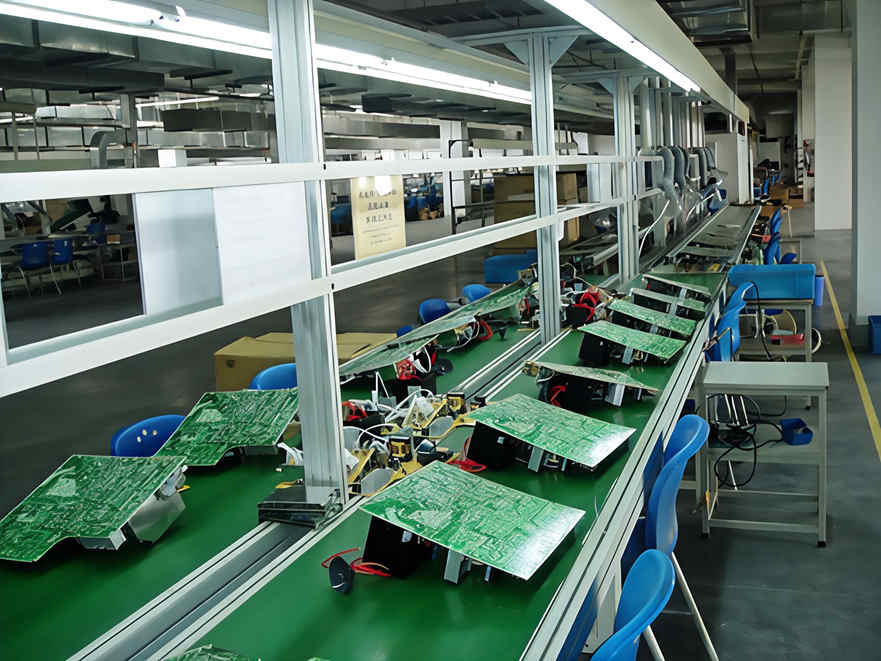
The core of the line utilizes anti-static PVC belts as the conveying medium, driven by circulation rollers. The belt surface is flat and continuous, allowing fixture boards (tooling plates) to be transported along with the belt. When a fixture board reaches a designated workstation, a photoelectric sensor detects the signal and a pneumatic stopper raises to halt the board, achieving precise in-situ positioning. While the belt continues to run, sliding friction between the board and the belt keeps the board stationary, enabling operators to perform insertion, soldering, or testing tasks. This mechanism allows workstations with varying cycle times—such as complex wire harness assembly for automotive electronics versus simple labeling for consumer electronics—to operate in coordination on the same line. Once the stopper lowers, the fixture board automatically resumes conveying under the friction of the belt.
2. Modular Frame and Adjustable Structure
The main frame is constructed from high-strength industrial aluminum profiles or high-quality bent steel plates with an anti-static spray coating. The line legs are equipped with M16 adjustable feet to accommodate uneven workshop floors. Belt tension is managed via screw-adjustment mechanisms, ensuring long-term operation without misalignment or slippage. The line width can be mechanically adjusted to accommodate PCB sizes ranging from 50mm x 50mm mini control boards to 500mm x 600mm industrial control motherboards, meeting the requirements for multi-industry board co-production.
3. Electrical Control and Speed Regulation System
The drive section employs a gear reduction motor coupled with drive rollers, paired with a variable frequency drive (VFD) to achieve stepless speed regulation from 0.5 to 15 m/min. The entire line is centrally controlled by a PLC and equipped with an operation panel, allowing settings for single-station manual/automatic modes, emergency stops, and fault alarms. Start/stop acceleration and deceleration curves are adjustable to prevent precision components from shifting or causing cold solder joints due to inertia.
4. ESD Protection and Workstation Facilities
To meet the Electrostatic Protection Area (EPA) requirements of the electronics industry, the conveyor belt is made of anti-static PVC material, and the fixture boards are made of anti-static bakelite or PVC sheets. The entire line is connected to the workshop grounding grid via copper strips to ensure effective static dissipation. Each workstation is standard-equipped with: LED lighting tubes, 220V power sockets, pneumatic quick-connect couplers, and A4 process document holders, facilitating operations such as insertion, screw tightening, soldering, and testing.
5. Equipment Integration and Scalability
Both ends of the line can be configured with lift-and-transfer units, elevators, or simple buffer tables to enable automatic fixture board return, forming a closed-loop system. It can also seamlessly interface with standard equipment such as wave soldering machines, selective soldering machines, AOI inspection machines, and ICT fixtures, establishing a complete automated line for the DIP and assembly stages.
Download PDF PDF / 133 KB
Previous: Tower Fan Assembly Line
Next: UAV Assembly Line