Abstract: This article focuses on small home appliance categories such as microwave ovens, rice cookers, induction cooktops, juicers, coffee machines, blenders, and air fryers. Targeting two major scenarios—main body assembly & testing, and light-load packaging & inspection—it compares the applicable boundaries of speed-multiplier chain lines and belt conveyor lines. It provides quantified selection parameters and a decision matrix across dimensions such as load, speed, accuracy, and cost, helping small appliance factories efficiently configure flexible assembly lines.
1. Main Body Assembly & Testing: Speed-Multiplier Chain Lines
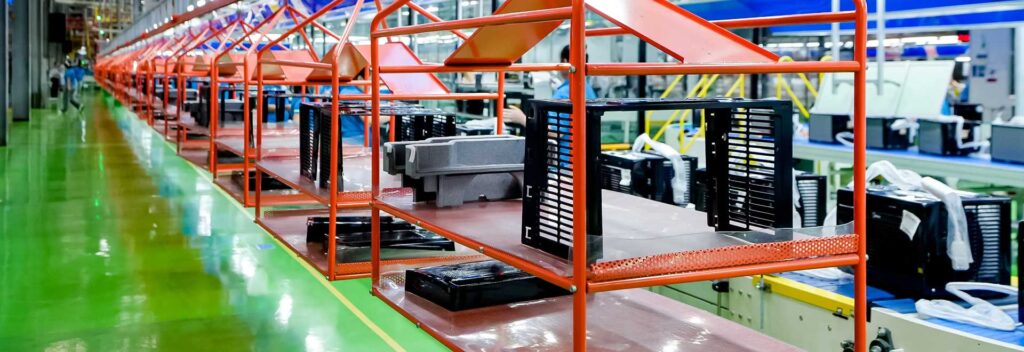
Suitable for medium-load cyclic assembly of microwaves, rice cookers, etc.
- Load Definition: Single-station load (workpiece + tooling pallet) in the range of 10-50 kg is typical for small appliances. Use 2.5x speed nylon roller chains, which are quiet and wear-resistant, with noise ≤ 65 dB.
- Tooling Pallet Specifications: Dimensions: 400×400 mm to 600×600 mm; material: 12-15 mm POM plate or acrylic plate. Four nylon swivel casters at the bottom, each with a load capacity of 50 kg.
- Workstation Configuration: Standard workstation spacing: 600-800 mm. Assembly stations are equipped with quick-connect pneumatic couplers; test stations integrate power sockets and signal acquisition ports, with conductive sliding rails embedded on the side of the tooling pallet.
- Flexible Design: Supports mixed-model production. Tooling pallets use RFID to identify models, and the PLC automatically switches stopper logic and test parameters. Changeover requires no pallet replacement—only fixture modules are adjusted.
- Return Efficiency: The empty pallet return line is arranged parallel to the assembly line. Return speed ≥ 1.2x the assembly line speed to avoid pallet shortages. The lift adopts a cam-type continuous lifting mechanism, which is more efficient than reciprocating types.
2. Light-Load Stations & Packaging Inspection: Belt Conveyor Lines
Suitable for plug-in assembly, inspection, and packaging of small items like juicers and coffee machines, offering smooth and low-noise operation.
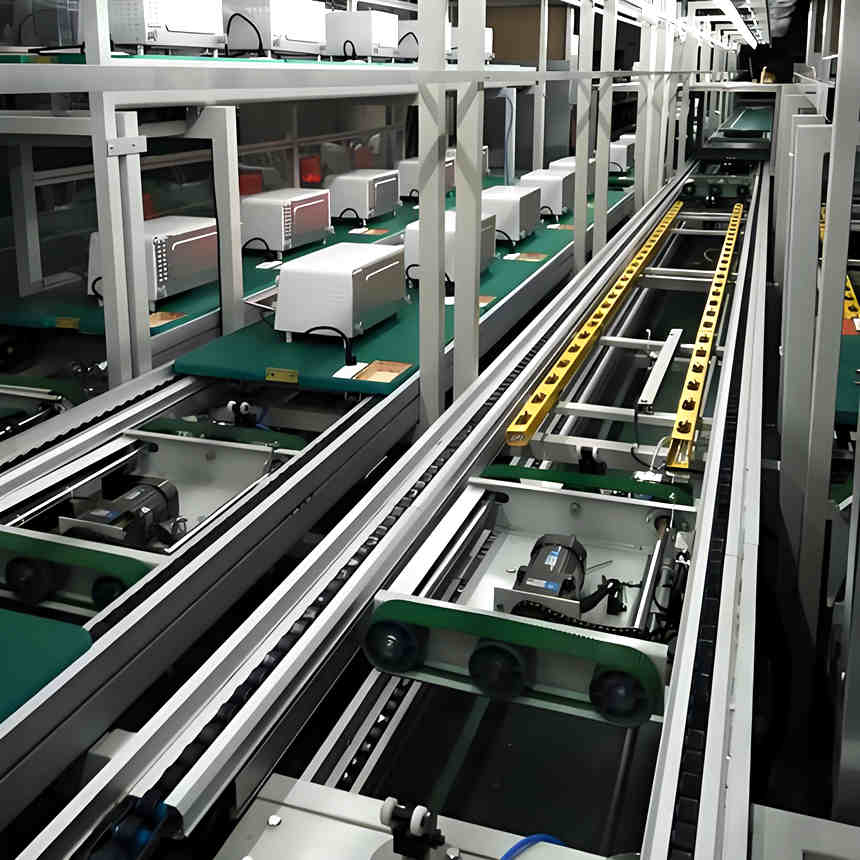
- Belt Selection: Anti-static green PVC belt, thickness 2-3 mm, tensile strength ≥ 10 N/mm. For food-grade products, use white PU belt that complies with FDA certification.
- Conveying Speed: Packaging section: 6-15 m/min; inspection section: 3-8 m/min. Variable frequency speed regulation with accuracy of ±1%.
- Frame Structure: 3030 or 4040 standard aluminum profiles, sufficient for light loads. The support plate under the belt is made of UHMWPE (ultra-high molecular weight polyethylene) for low friction coefficient and reduced belt wear.
- Alignment & Tensioning: Manual screw tensioning at the tail, with a travel of 50 mm. For long-distance lines (> 8 m), a pneumatic automatic deviation correction device is added, with deviation ≤ 5 mm.
- Interface with Speed-Multiplier Chains: Transition rollers are installed at belt line inlets/outlets, with height difference ≤ 2 mm. When transferring materials from a speed-multiplier chain pallet to a belt line, a pusher or fork mechanism is used, with action time ≤ 1 second.
3. Speed-Multiplier Chain vs. Belt Line Selection Decision Matrix
| Comparison Dimension |
Speed-Multiplier Chain Line |
Belt Conveyor Line |
| Single-Station Load |
10-120 kg |
≤ 30 kg (evenly distributed across the line) |
| Accumulation Function |
Built-in differential accumulation |
None (requires additional buffer mechanism) |
| Positioning Accuracy |
±0.5 mm (up to ±0.2 mm with lift) |
±2-5 mm |
| Changeover Flexibility |
High (modular pallets) |
Low (requires belt width/guard adjustment) |
| Noise Level |
60-70 dB |
50-60 dB |
| Cost per Unit Length |
Higher |
Lower |
| Applicable Processes |
Assembly, testing, aging |
Packaging, inspection, light-load transfer |
4. Selection Considerations
- Calculate Load Before Finalizing Type: Always calculate the total weight of “workpiece + tooling pallet + fixtures” and reserve a 20% safety margin. Selecting based solely on product net weight is a common mistake.
- Speed Matches Cycle Time: Do not blindly pursue high speeds. For small appliance assembly lines, 8-12 m/min is usually sufficient; excessive speed increases failure rates and operator fatigue.
- Environmental Adaptation: For cleanrooms, select stainless steel frames + anti-static belts; for humid environments, galvanized chains + waterproof motors; for oily environments, oil-resistant belts + sealed bearings.
- Expansion Reserve: Reserve 10%-15% expansion space in line length, and 20% spare circuits in the electrical cabinet, to accommodate future capacity increases or process changes.
Download PDF PDF / 141 KB