Drum Washing Machine Assembly Line
1. Overview: From Washing Machine Types to Assembly Solutions In the home appliance manufacturing sector, washing[…]
Email:[email protected]
We are a home appliance assembly line manufacturer.
Tel:+86-13858631358 Mail:[email protected]
1. Overview: From Washing Machine Types to Assembly Solutions In the home appliance manufacturing sector, washing[…]
In the home appliance manufacturing sector, washing machines are primarily categorized into two structural types: top-load (pulsator) washing machines and front-load (drum) washing machines.
Top-load washing machines rely on a pulsator at the bottom of the tub that rotates clockwise and counterclockwise to create water flow. Cleaning is achieved through friction. These machines have a relatively simple structure—essentially a single inner drum with a top-opening lid—resulting in fewer assembly steps and a straightforward production process.
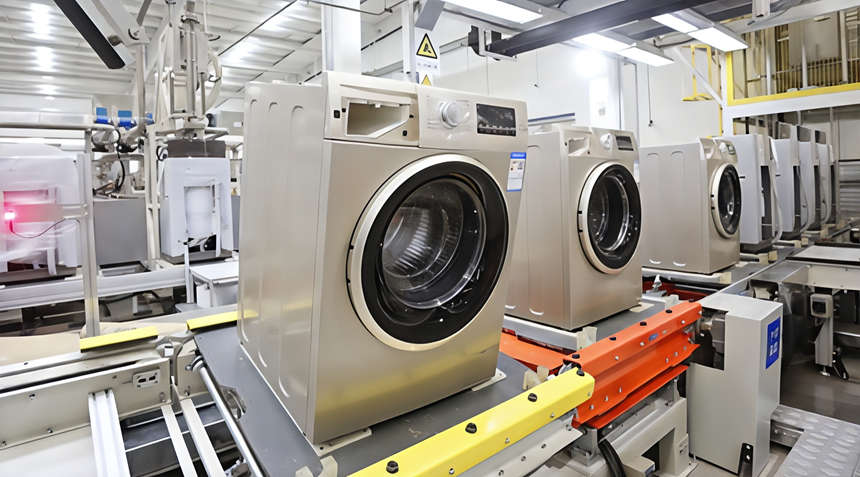
Front-load (drum) washing machines, by contrast, feature a horizontally mounted drum. During operation, clothes are lifted by the drum wall and then dropped by gravity, achieving cleaning through a “drop-and-beat” mechanical action. Compared to pulsator models, drum washing machines incorporate additional components: concrete counterweights, a shock absorption system, a door seal (gasket), a heating element, and a door lock mechanism. The finished unit is significantly heavier (typically 60–80kg net weight) and involves more complex assembly processes. This demands higher load-bearing capacity, positioning accuracy, and electrical testing capabilities from the drum washing machine production line.
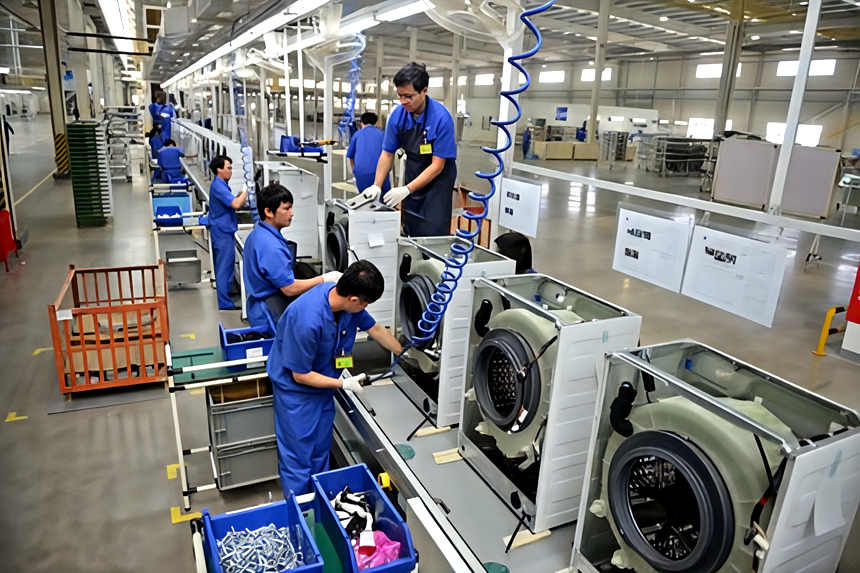
To meet these specific structural and assembly requirements, our drum washing machine assembly line is engineered to handle the complete manufacturing cycle—from chassis loading, inner drum assembly, and cabinet enclosure, to counterweight installation, pipe routing, electrical wiring, door assembly, functional testing, and final packaging.
Chassis & Inner Drum Pre-Assembly
On the pre-assembly station, shock absorbers (4 sets), the inner drum assembly, the motor, and the pulley are mounted sequentially onto the chassis fixture. Motor fastening is performed using torque-controlled pneumatic wrenches with a setting range of 8–12 N·m, ensuring consistent belt tension across all units. Once completed, a lift transfer mechanism moves the chassis assembly to the main washing machine conveyor line.
Cabinet Enclosure & Alignment
The outer cabinet (sheet metal or PP plastic) is hoisted—either manually or with a balancer arm—and fitted over the positioned inner drum assembly. Positioning fixtures on both sides of the drum washer assembly line ensure coaxial alignment between the cabinet and chassis, with a deviation of ≤ 1.5mm. After alignment, side-panel connecting bolts are fastened using automatic or manual screw machines at 5–8 N·m torque.
Counterweight & Pipe Routing
Top and front concrete/cast-iron counterweights (single block weight: 15–25kg) are assisted into position using spring-balanced lifting arms. Fastening bolts are tightened to 15–20 N·m. Inlet hoses, drain pump pipes, power cords, and ground wires are then connected. All tubing and wiring are secured with clips at intervals of ≤ 150mm to prevent vibration-induced wear.
Door Assembly
After installing the front door hinge and glass assembly, technicians adjust the door-to-cabinet gap to a uniform 3–5mm on all four sides. The door lock connector is plugged in and pressed firmly into place using a dedicated jig.
End-of-Line Testing (EOL)
Fully assembled units enter the testing station for a comprehensive quality check:
Packaging & Off-Line
After passing all tests, the unit is automatically wrapped in PE film. Accessories and user manuals are inserted manually, followed by automatic carton folding, sealing, and strapping. Finished products are conveyed via roller line to the palletizing area or AGV docking station.
| Parameter | Specification |
|---|---|
| Conveyor Type | Twin-speed chain / Slat chain conveyor (optional) |
| Total Line Length | 30m / 40m / 60m (customized by station count) |
| Line Width | 1200mm (effective conveying surface: 800mm) |
| Number of Stations | 16–24 stations (pre-assembly, main assembly, testing, packaging) |
| Station Pitch | 2000mm |
| Conveyor Speed | 0–5 m/min, VFD stepless speed regulation |
| Max. Load Capacity | ≥ 120kg per station |
| Positioning Accuracy | Work pallet stop position: ±3mm |
| Drive Power | 2.2kW (main line), 1.5kW (pre-assembly line) |
| Operating Voltage | AC 380V, 3-phase 5-wire, 50Hz |
| Air Supply Pressure | 0.5–0.7 MPa, G1/2″ interface |
| Pneumatic Tool Consumption | Approx. 200L/min (total line) |
| Ground Resistance Tester | Range: 0–200mΩ, Accuracy: ±1% |
| Hipot Tester | Output: 0–5kV AC, Accuracy: ±2% |
| Noise Test Room | Background noise ≤ 35dB(A), Frequency response: 20Hz–20kHz |
| Control System | PLC + HMI (brand optional), with photoelectric sensors, emergency stop circuit, and audible/visual alarms |
| Takt Time / Cycle Time | 30–60 seconds per unit (adjustable based on configuration) |
| Applicable Models | Drum washing machines, capacity 6–12kg; Unit dimensions: 595–600mm (W) × 450–650mm (D) × 840–850mm (H) |
Download PDF PDF / 211 KB
Previous: Gas Cooker Assembly Line
Next: