Abstract: This technical manual serves manufacturers of side-by-side refrigerators, cross-door refrigerators, French door multi-door refrigerators, built-in refrigerators, and commercial freezers. It breaks down the technical specifications for heavy-duty flat-top slat chain conveyors, speed-multiplier chain conveyors, roller conveyors, and overhead conveyor chains across four key processes: main assembly line, sub-assembly branch lines, cabinet on-line packaging, and painting & curing. It provides quantitative selection criteria for the entire refrigerator manufacturing conveying system.
1. Main Assembly Line: Heavy-Duty Flat-Top Slat Chain Conveyors
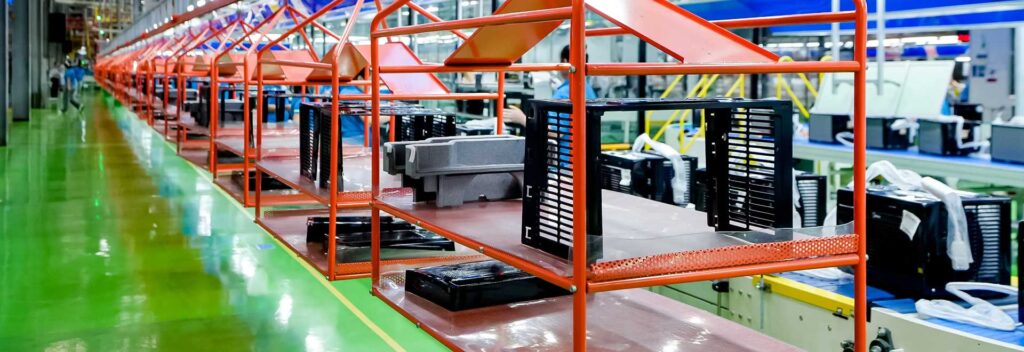
Refrigerator cabinets are heavy (60-120 kg) and irregularly shaped, making slat chain conveyors the ideal main assembly carrier.
- Slat Selection: Pitch: 100-150 mm; flat plate width: 800-1200 mm. Material: Q235 steel plate with thickness ≥ 4 mm, or stainless steel 304 (for cleanroom requirements). Surface flatness deviation: ≤ 2 mm/m.
- Load Capacity: Single-station rated load: 150-300 kg. A dynamic impact factor of 1.5 must be included in the design. Chain tensile strength: ≥ 25 kN.
- Guide Rails & Supports: Double-sided guide rails use 8# channel steel or specialized aluminum profiles. Intermediate supporting rollers are added with spacing ≤ 800 mm to prevent slat sagging and deformation.
- Drive & Tensioning: Head drive motor power: 3-7.5 kW; reducer gear ratio: 40-60. Tail hydraulic automatic tensioner with adjustable tension range of 2-8 kN.
- Tooling Adaptation: Removable locating pins or profiled pads are installed on the slats to accommodate different refrigerator base models, with changeover time controlled within 15 minutes.
2. Sub-Assembly Branch Lines (Door Bodies & Compressors): Speed-Multiplier Chain Conveyors
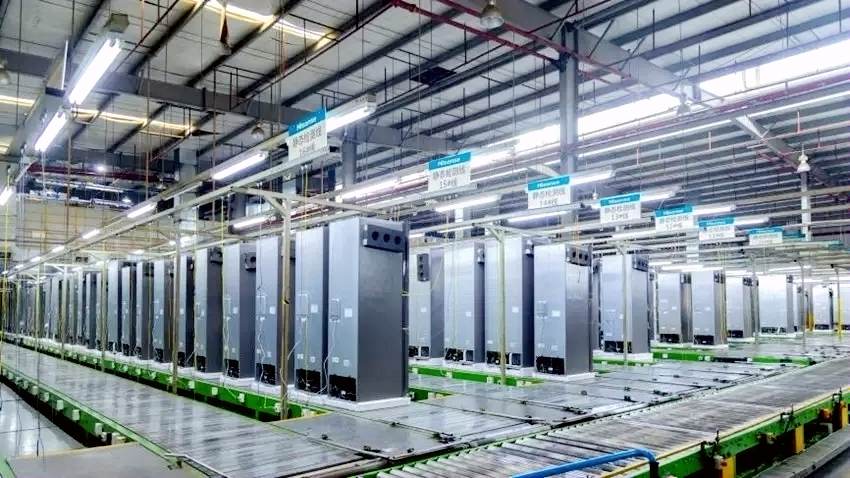
Used for precision assembly, evacuation (vacuuming), and commercial inspection, allowing tooling pallets to accumulate.
- Chain Types: Door assembly lines have light loads (10-30 kg) and use 2.5x speed nylon roller chains. Compressor lines have medium loads (30-80 kg) and use 3x speed metal roller chains.
- Accumulation Logic: Utilizes a differential speed principle. Tooling pallets automatically stop and accumulate before a stopper, then accelerate to catch up after release. Accumulation zone length is calculated as: max buffer count × pallet length × 1.2 (safety margin).
- Dedicated Machine Interfaces: Vacuum stations reserve channels for vacuum pipelines. Commercial inspection stations integrate grounding terminals for withstand voltage testers, with copper strips embedded in the tooling pallets for electrical conduction.
- Return System: A lift-and-transfer device at the end transfers empty pallets to the lower return line, operating at the same speed as the main line.
3. Cabinet On-line & Finished Product Packaging: Roller Conveyors
Sheet metal parts entering the line and finished product palletizing.
- Sheet Metal On-line Section: Roller diameter: 76 mm; wall thickness: 2 mm; surface coated with polyurethane (PU) to prevent scratches. Inclined section angle: ≤ 15° to prevent sheet metal from sliding off.
- Finished Product Packaging Section: Heavy-duty rollers with diameter 89 mm, wall thickness 3 mm, and single-roller load capacity ≥ 200 kg. Transition plates with gap ≤ 5 mm are installed at interfaces with automatic wrapping machines and palletizing robots.
- Diverging & Merging: 90° lift-and-transfer mechanisms or diagonally intersecting rollers are used for multi-line merging, with diverging efficiency ≥ 30 cartons/minute.
4. Cabinet Painting & Curing: Overhead Conveyor Chains
Overhead processes including pre-treatment, powder coating, and curing ensure uniform coating without occupying floor space.
- Temperature Resistance: Curing oven temperature: 180-220°C. Chains must be made of high-temperature alloy steel (e.g., 20MnVB), with grease dropping point ≥ 250°C.
- Hanging Density: Hanger spacing is determined by workpiece length plus hot air circulation space, typically 800-1200 mm. Hanger self-weight must be included in chain load verification.
- Pre-treatment Section: Tracks in the spray zone require anti-corrosion treatment (hot-dip galvanizing or stainless steel), with drainage slope ≥ 2%.
- Speed Matching: Coating line speed is determined by curing time and oven length, V = L / T. For example, with an oven length of 60 m and curing time of 30 min, the line speed is 2 m/min. VFD speed range: 0.5-3 m/min.
Download PDF PDF / 140 KB