Abstract: Targeting manufacturers of front‑loading washing machines, top‑loading washing machines, washer‑dryer combos and commercial laundry equipment, this paper provides engineering‑level selection parameters and configuration essentials for speed‑multiplier chain conveyors, overhead chain systems, roller conveyors and slat chain conveyors for four core processes: final assembly & testing, overhead component transfer, finished‑product packaging and heavy‑duty chassis assembly. It covers technical decision‑making for conveying equipment for both household and industrial‑grade washing machine production lines.
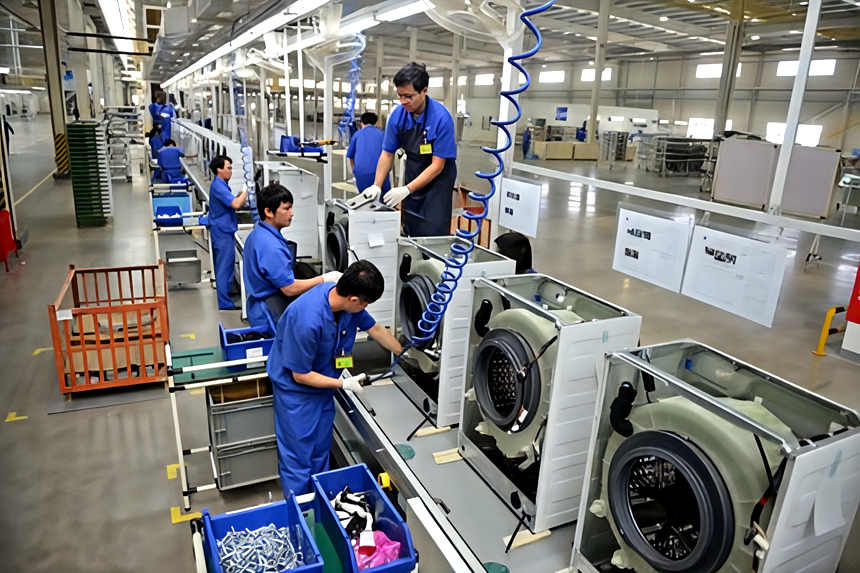
1. Final Assembly and Testing Section: Speed‑multiplier Chain Conveyors
Speed‑multiplier chain conveyors are adopted for washing machine final assembly lines to meet the requirements of multi‑station cycle‑time synchronization and on‑line aging tests.
Chain Specifications: For single‑station load (workpiece + tooling pallet) ranging from 30‑60 kg, adopt BS30 2.5‑speed nylon roller chains. For loads of 60‑100 kg, adopt BS40 3‑speed metal roller chains. Apply a safety factor of 1.2.
Tooling Pallet Design: Expand dimensions by 50 mm beyond the projected footprint of the washing‑machine base. Use 18 mm‑thick POM plates or steel plates, with anti‑static rubber sheeting bonded to the surface. Fit four swivel casters at the bottom; each caster shall have a load‑bearing capacity ≥ 150 kg.
Positioning Accuracy: Equip with cylinder stoppers and hydraulic shock absorbers for repeat positioning accuracy of ± 0.5 mm. If automatic torque guns or electrical test probes are to be integrated, add a lifting‑and‑positioning mechanism with lifting force ≥ 200 kg.
Drive Configuration: Motor power calculation formula: P(kW) = [Total Load (kg) × Friction Coefficient (0.15‑0.2) × Speed (m/min)] ÷ 6120. Standard operating speed for washing‑machine final‑assembly lines is set at 6‑12 m/min, with variable‑frequency speed‑adjustment range of 3‑15 m/min.
Aging‑Zone Integration: The aging zone adopts a double‑deck speed‑multiplier chain structure: the upper deck for powered aging tests and the lower deck for empty‑pallet return flow. Aging duration is controlled by PLC‑actuated opening/closing of stoppers; dwell time for each station can be set independently.
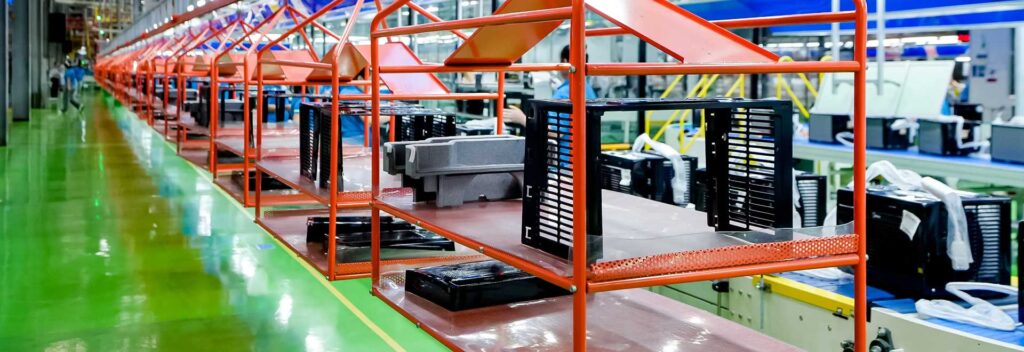
2. Material and Sub‑Assembly Overhead Transfer: Overhead Chain Conveyor System
Used for overhead delivery of components such as chassis and inner drums from sub‑assembly areas to the final‑assembly line.
Track Selection: For single‑point lifting load ≤ 50 kg, select QXG‑series light‑duty tracks (section height 78 mm). For 50‑120 kg, select XT‑series standard tracks (section height 100 mm). Tracks are made of cold‑rolled steel with wall thickness ≥ 3 mm.
Hanger Spacing: Determined by the maximum overall dimension of components plus safety clearance, typically 600‑900 mm. Hangers shall allow rotation to cover component‑picking orientations for assembly; 360° self‑rotating hooks are recommended.
Conveying Speed: Matched to the cycle time of the final‑assembly line; normally runs continuously or in stepping mode at 4‑8 m/min. Turning radius ≥ 600 mm to prevent swinging and collision of components.
Lifting Section: Install electrically‑driven lifting sections for height differences > 1.5 m, with lifting speed of 3‑6 m/min and anti‑fall ratchet mechanisms.
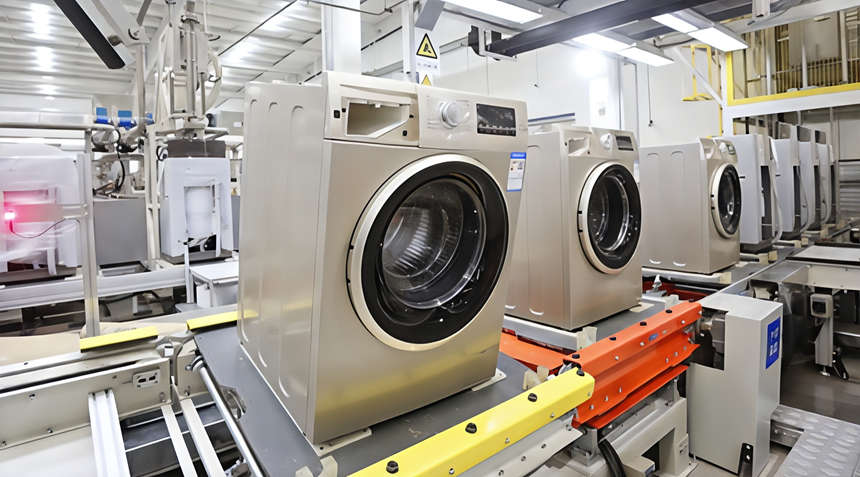
3. Finished‑Product Off‑line and Packaging Section: Roller Conveyors
Carry flat‑bottom finished‑product cabinets to complete transfer from final assembly to packaging.
Roller Specifications: Galvanized steel tubes with diameter 50‑76 mm and wall thickness ≥ 1.5 mm. Shaft diameter 12‑15 mm; adopt 6204‑2RS sealed bearings.
Spacing Setting: Roller centre‑to‑centre distance ≤ 1/3 of the shortest side of the product base surface, ensuring at least three rollers support the product simultaneously. For finished washing‑machine units, 100‑150 mm spacing is commonly used.
Drive Modes: O‑belt drive for lengths < 10 m; poly‑V‑belt or chain drive for 10‑20 m; sectional drive with independent motors for each segment for lengths > 20 m.
Accumulation Function: Power‑driven rollers paired with photoelectric sensors are used in pre‑packaging buffer zones to achieve zero‑pressure accumulation and avoid squeeze‑induced damage to finished goods.
4. Heavy‑duty Irregular‑shape Chassis Stations: Supplementary Slat Chain Conveyors
For assembly processes requiring heavy‑load capacity or rigid support (e.g., counterweight installation, shock‑absorber press‑fitting).
Slat‑chain Parameters: Pitch 63.5‑101.6 mm; slats are Q235 steel plates with thickness ≥ 3 mm and width 400‑800 mm. Single‑station load capacity: 200‑500 kg.
Operation Mode: Cycle‑time‑based operation with positioning accuracy ± 1 mm. Interfaces with the main speed‑multiplier chain line via lifting transfer machines.
Tensioning Device: Fit screw‑type tensioners or automatic spring‑loaded tensioners at the tail with travel ≥ 100 mm to compensate for chain elongation.
Download PDF PDF / 209 KB