We are a home appliance assembly line manufacturer.
Tel:+86-13858631358 Mail:[email protected]
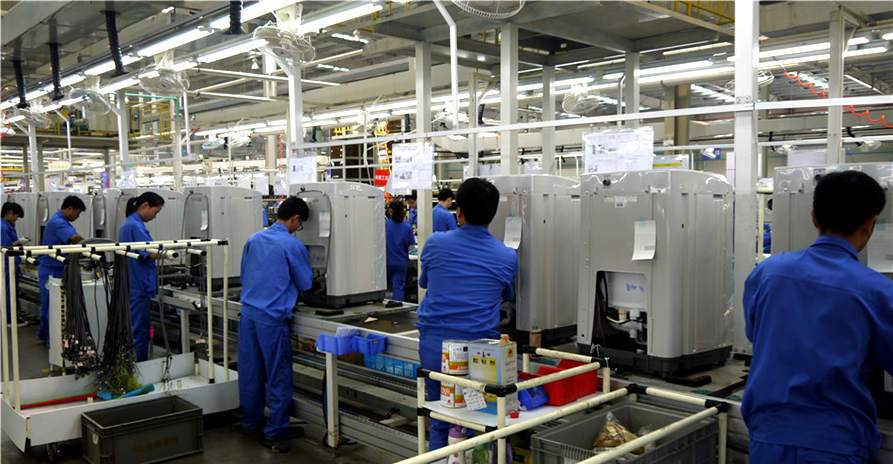
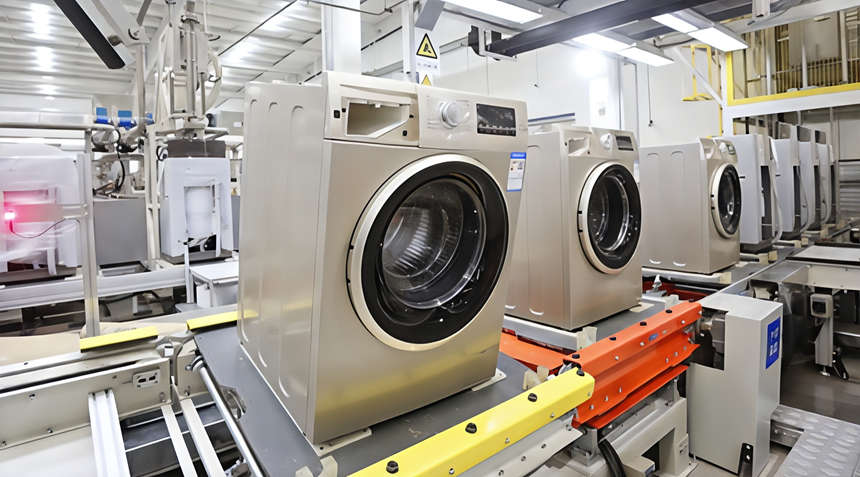
Walk into the assembly workshop of any domestic washing machine drum assembly line, and you’ll see a starkly contrasting scene. On one side, there’s a highly automated inner drum assembly line where robotic arms move with flawless fluidity. On the other side, in front of a specific station on the final assembly line, you’ll often find a pile-up of “half-paralyzed” washing machine units. Workers at the preceding stations have no choice but to stop their tasks, staring helplessly at the bottleneck ahead—the balance weight installation station.
Why does a well-designed washing machine assembly line always get “constipated” at this stage? Why, no matter how hard the preceding stations work, can’t the overall line output increase? Today, we start with this overlooked “balance weight station” to discuss a truth about the washing machine assembly line that overseas buyers figured out long ago, but domestic factories are still stubbornly fighting against.
First, a basic industry fact: on a washing machine drum assembly line, drum washers absolutely must have balance weights.
Unlike pulsator washers, a drum washer’s inner drum rotates at speeds of 1,200 to 1,400 RPM during high-speed spin cycles. Without sufficient counterweights to offset the eccentric vibration, the machine will “tap-dance” all over the floor. Therefore, on the final assembly section of the washing machine assembly line, workers must lift heavy concrete or composite balance weights (usually two pieces, top and bottom, weighing 5 to 10 kg each) into the bottom of the washer, align the holes, and securely fasten them with screws or zip ties.
This station sounds simple, but the manual operation time fluctuates drastically—usually by ±15 seconds.
Why is the fluctuation so large?
What does this ±15-second fluctuation mean for washing machine assembly line management? If the standard cycle time is 60 seconds, some units might be finished in 45 seconds, while others take 75 seconds. This 15-second “excess time” is the seed of a line blockage.
In a traditional linear washing machine assembly line layout, there is almost no buffer between stations (WIP is zero). This means if the station ahead hasn’t cleared, the next station cannot move.
When the balance weight station takes an extra 20 seconds because a screw stripped, there’s nowhere to put the next unit, so the preceding stations must stop and wait. And what usually comes before the balance weight station? Critical processes like inner drum pre-assembly, door seal installation, and control panel wiring. Once these stop, the “effective output time” of the entire washing machine drum assembly line is shattered.
Worse still, this waiting has a cumulative effect. According to the “traffic jam model” in queuing theory, when the Coefficient of Variation (CV) from upstream stations hits a bottleneck station, the waiting time downstream amplifies exponentially. Simply put: for every extra 1 second the balance weight station takes, the upstream station might have to wait 3 seconds or more.
This is why many team leaders frantically urge upstream workers to “hurry up,” only to make things worse—because the root cause isn’t upstream; it’s the “intestinal blockage” at the balance weight station.
Facing this pain point, the first reaction of many domestic washing machine assembly line planning teams is: “Speed up the upstream stations, or hire another person for the balance weights.” So they add manpower and forcibly compress the cycle time. The result? Labor costs go up, but the blockage persists because the variation is still there.
Meanwhile, overseas buyers (especially equipment planning teams for washing machine drum assembly lines in Japan, South Korea, and Europe) often suggest something that initially confuses domestic engineers:
“Add a buffer station (cache area) before the balance weight station.”
This buffer can be a simple extended roller conveyor section or a lift table that holds 3 to 5 units of Work in Progress (WIP).
What’s the logic?
This isn’t high-tech; it might only cost a few thousand dollars. But it instantly transforms the washing machine assembly line from “hard-coupled” stations to “soft-coupled” ones. The wisdom of overseas buyers lies in this: they don’t try to eliminate variation (since human operational variation is an objective law); they use a buffer to absorb it.
Here we must correct the most common misconception in the domestic washing machine assembly line manufacturing sector:
❌ “Line cycle time is determined by the fastest station.”
❌ “As long as every station is faster than the target cycle time, the whole line will meet its quota.”
The truth is:
✅ The actual output cycle time of a washing machine assembly line is jointly determined by the slowest station plus the Coefficient of Variation (CV).
Expressed as a formula (a simplified understanding based on the queuing theory Kingman formula):
Actual Output Cycle ≈ Bottleneck Station Cycle × (1 + CV² / 2)
Let’s look at an example:
The larger the coefficient of variation, the more severely the bottleneck station drags down the whole line. This is why some factories measure every station as “meeting the standard,” yet the washing machine drum assembly line never reaches its designed capacity—because they measure “average time,” while the production line actually runs on “variation time.”
To answer the title’s question: Why is your washing machine assembly line always waiting?
Because you are using a “rigid” production line to fight against “flexible” variation. The balance weight station isn’t impossible to optimize (e.g., switching to automatic screw machines, incoming material error-proofing for weights, or even using collaborative robots for lifting). But before making those heavy investments, first add a buffer to your washing machine drum assembly line, and first admit that “variation is the norm.” That is true Industrial Engineering thinking.
Overseas buyers look at the system; domestic factories often look at single points. Next time you stand in front of a washing machine assembly line and see workers scrambling at the balance weight station, don’t rush to urge them to go faster. Go see if there is space for a buffer in front of them, and check if your cycle time formula includes the Coefficient of Variation.
Download PDF PDF / 216 KB
Next: